From spiritual purification to lasting rewards, Explore why Hajj and Umrah are among the greatest acts of worship in Islam and what every pilgrim should know.
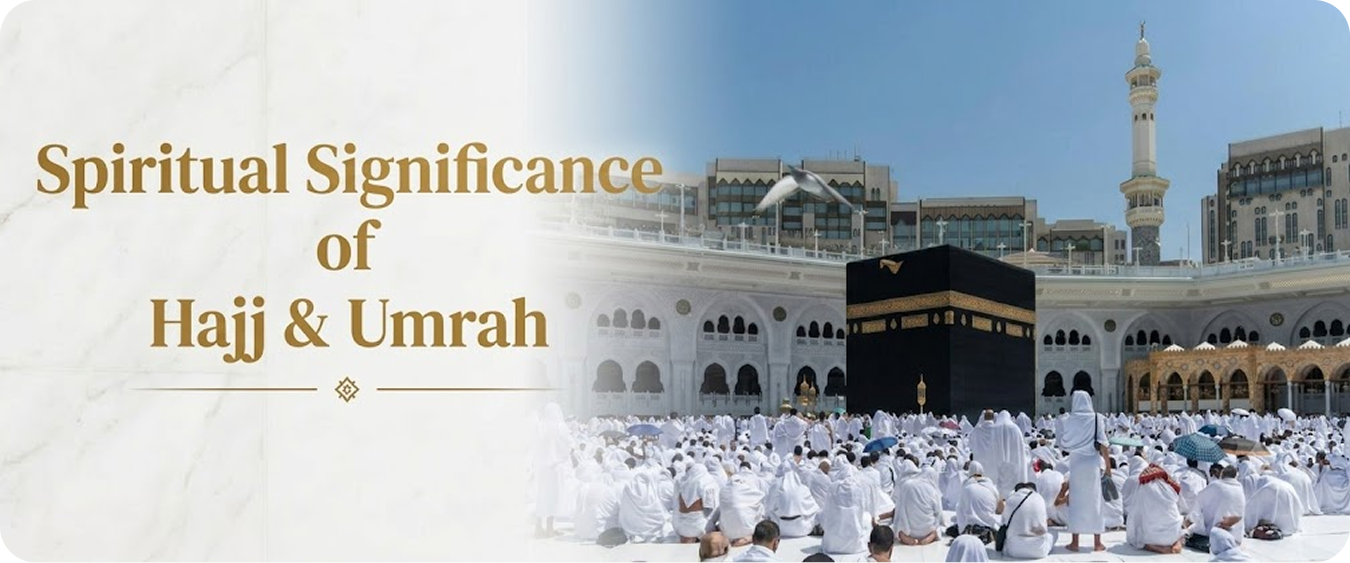
"And proclaim to the people the Hajj; they will come to you on foot and on every lean camel; they will come from every distant mountain pass."
(Surah Al-Hajj, 22:27)
For centuries, this divine invitation has continued to reach the hearts of Muslims around the world, inspiring millions to answer Allah's call. Long before a pilgrim arrives in Makkah, the journey begins with sincere faith, a clear intention, and a deep desire to seek Allah's pleasure.
Standing before the Holy Kaaba alongside believers from every nation, all proclaiming "Labbayk Allahumma Labbayk" (Here I am, O Allah, here I am), is a powerful reminder of the unity, equality, and devotion that Islam teaches.
Yet the true significance of Hajj and Umrah in Islam extends far beyond travelling to a sacred place. These blessed pilgrimages strengthen faith, encourage repentance, purify the heart, and draw believers closer to Allah through acts of worship and complete submission. But what makes Hajj and Umrah so important in Islam?
In this guide, you'll discover their meaning, importance, spiritual significance, rewards, key rituals, and the lasting lessons they leave in every believer's life.
Hajj is the annual pilgrimage to Makkah and one of the Five Pillars of Islam. It is obligatory once in a lifetime for every Muslim who is physically, mentally, and financially able. Performed during Dhul Hijjah, Hajj includes rituals such as Tawaf, Sa'i, and standing at Arafat. It symbolizes faith, unity, sacrifice, and complete submission to Allah.
Umrah is a voluntary Islamic pilgrimage to Makkah that can be performed at any time of the year. It involves entering the state of Ihram, performing Tawaf around the Kaaba, walking between Safa and Marwah (Sa'i), and shaving or trimming the hair. Although not obligatory like Hajj, Umrah is a highly rewarding act of worship that strengthens faith, brings spiritual purification, and draws Muslims closer to Allah.
Feature | Hajj | Umrah |
| Obligation | Mandatory (if able) | Voluntary |
| Time | 8–13 Dhul Hijjah only | Any time of the year |
| Duration | 5–6 days | Few hours to 1 day |
| Rituals | Includes Ihram, Tawaf, Sa'i, Arafat, Muzdalifah, Mina, and Jamarat | Includes Ihram, Tawaf, Sa'i, and shaving or trimming the hair |
| Status | One of the Five Pillars | Voluntary (Sunnah) act of worship |
Why does Islam place such great importance on Hajj?
Hajj is a sacred act of worship that every eligible Muslim is required to perform once in their lifetime. It is a journey of faith that deepens a believer's connection with Allah through sincere worship, prayer, and remembrance. Hajj also commemorates the devotion and obedience of Prophet Ibrahim (AS), Hajar (RA), and Prophet Ismail (AS), serving as a powerful reminder of trust in Allah and commitment to His commands.
Allah says in the Qur'an:
"And Hajj to the House is a duty owed to Allah by all people who are able to undertake it. And whoever disbelieves, then indeed Allah is free from need of the worlds."
(Surah Aal 'Imran, 3:97)
This verse clearly establishes the importance of Hajj in Islam and reminds believers that the obligation applies only to those who have the means to undertake it.
Answering Allah's call is both a privilege and a responsibility. It reflects a believer's willingness to fulfil one of Islam's greatest obligations with sincerity, trusting that every step taken towards His House is an act of worship that brings immense reward.
If Umrah is not obligatory, why do so many Muslims choose to perform it?
Although Umrah is a voluntary pilgrimage, it is a highly recommended act of worship in Islam. It provides believers an opportunity to deepen their faith, seek Allah's mercy, and renew their devotion outside the Hajj season. Because Umrah can be performed throughout the year, Muslims are able to visit the Holy Kaaba whenever they have the ability and sincere intention to do so.
The Prophet Muhammad ﷺ said:
"One Umrah to the next is an expiation for the sins committed between them, and an accepted Hajj has no reward except Paradise."
(Sahih al-Bukhari, Hadith 1773; Sahih Muslim, Hadith 1349)
This Hadith emphasises the importance of Umrah in Islam and indicates that every true pilgrimage is a chance to get closer to Allah and to ask for His mercy. While Umrah does not replace the obligation of Hajj, it is one of the most rewarding voluntary acts of worship and a beautiful way to increase devotion throughout the year.
The rewards of Hajj and Umrah in Islam are among the greatest blessings promised to sincere believers. Every act of worship performed during these sacred pilgrimages carries immense spiritual value.
These rewards show that sincere effort in pilgrimage is never lost in the sight of Allah.
What lessons do Hajj and Umrah leave in a believer’s life?
These pilgrimages shape a person’s faith, character, and relationship with Allah in ways that remain long after the journey ends.
These lessons do not remain limited to the pilgrimage itself. They continue shaping a believer’s behaviour, mindset, and faith long after returning home.
Why is unity so strongly emphasised during Hajj and Umrah in Islam?
These pilgrimages bring Muslims from all over the world together in one place with a shared purpose.
It strengthens bonds that go beyond nationality, language, culture, and social status, reflecting the equality and brotherhood that Islam teaches.
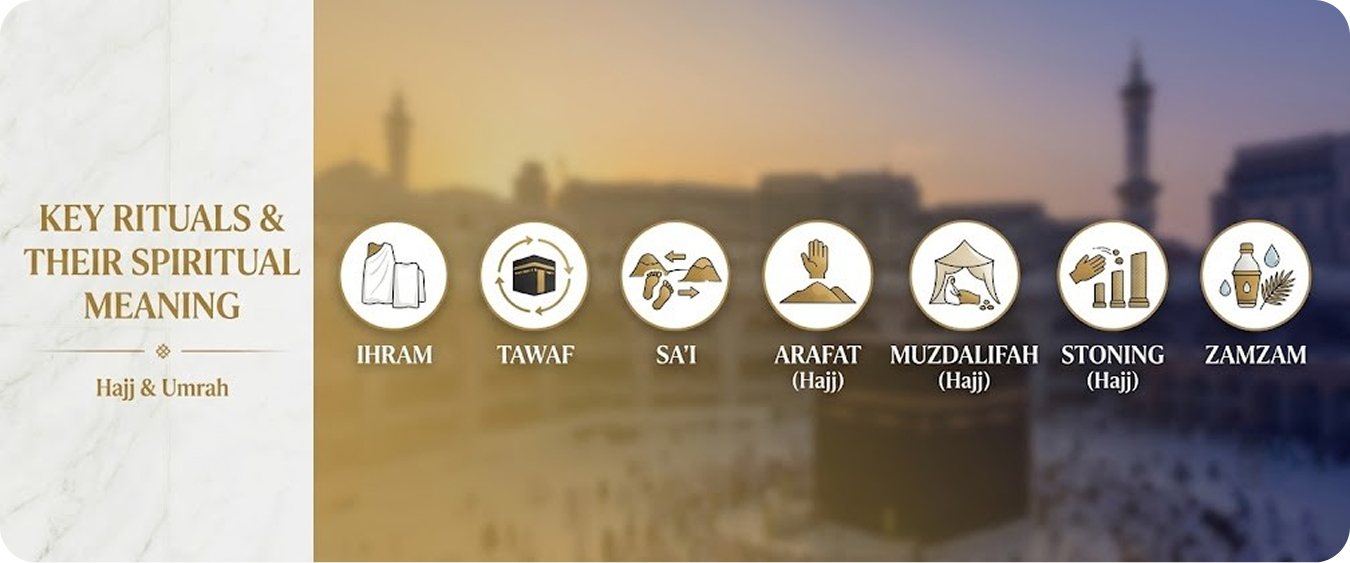
What happens in Hajj and Umrah, and what does each step mean?
These rituals are performed in a fixed order and each one has a clear purpose. Understanding them makes the journey easier and more meaningful.
Each ritual is simple in action but powerful in meaning. Together, they guide a believer toward obedience, discipline, and closeness to Allah.
So before someone actually travels for Hajj or Umrah, what should they focus on first?
Honestly, most people think preparation starts with flights and hotel bookings. But in reality, it begins much earlier with the heart.
And perhaps the most important part? Don’t rush this stage.
Because when the heart is prepared properly, the journey itself feels very different. It becomes less about travel… and more about returning to Allah with full awareness and sincerity.
There are a few common misunderstandings people often have about Hajj and Umrah, especially before learning about their true rulings. Let’s clear them in a simple way.
One common question is whether Muslims need to perform Hajj more than once. The truth is that Hajj is only obligatory once in a lifetime for those who are physically and financially able. Any additional Hajj is voluntary.
Another misunderstanding is that performing Umrah removes the need for Hajj. In reality, Umrah is a separate act of worship and does not replace the obligation of Hajj.
Some people also think Umrah must be repeated regularly. However, Umrah is not compulsory at all, it is a voluntary act of worship, even though many choose to perform it more than once for spiritual benefit.
There is also a belief that Hajj and Umrah are only about travel arrangements. While planning is important, the real foundation of both is spiritual preparation, sincere intention, and closeness to Allah.
Once these points are understood clearly, Hajj and Umrah in Islam become much more meaningful, not simply as journeys, but as acts of worship built on faith, purpose, and complete submission to Allah.
Planning for Hajj or Umrah involves more than booking flights and accommodation. Understanding the importance of Hajj and Umrah in Islam helps pilgrims prepare both spiritually and practically for this sacred journey. Pilgrims also need to arrange visas, hotels, airport transfers, and other essential travel services. Managing everything separately can be challenging, which is why many UK pilgrims choose to book through a trusted Hajj and Umrah travel agency.
A reliable agency manages every part of the pilgrimage, allowing every pilgrim to focus on their spiritual preparation instead of travel logistics. When choosing a travel provider, look for experience, transparent pricing, quality accommodation, and dedicated customer support.
Alhijaz Tours offers carefully designed Hajj packages and Umrah packages for UK pilgrims, with flights, accommodation, visa assistance, and ground transportation arranged under one package for a smoother and more comfortable experience.
Answer Allah’s call with confidence and begin your sacred pilgrimage today. Book Hajj and Umrah from UK with Alhijaz Tours, and let our experienced team manage your travel arrangements so you can focus on worship, reflection, and your spiritual journey.
Hajj is performed annually in Dhul Hijjah, with the main rites taking place between the 8th and 13th. The most important day is the 9th of Dhul Hijjah at Arafat.
Umrah includes Ihram, Tawaf, Sa’i, and haircut, while Hajj includes these plus Arafat, Muzdalifah, Jamarat, sacrifice, and additional Tawaf rituals over specific days.
Prepare with sincere intention, learn the rituals, seek forgiveness, increase worship, and arrange visas, documents, accommodation, and transport early.
A trusted Hajj and Umrah travel agency like Al Hijaz Tours manages visas, flights, accommodation, and transfers, ensuring a smooth, stress-free pilgrimage experience.
Most Hajj packages UK and Umrah packages UK include flights, accommodation, visa assistance, airport transfers, and dedicated travel support.
Talk to our travel specialists and get the best available options tailored for you.
Get Started