Find Umrah duas in Arabic, transliteration and English translation, from entering Ihram to Tawaf, Sa’i, Quranic prayers and completing Umrah.

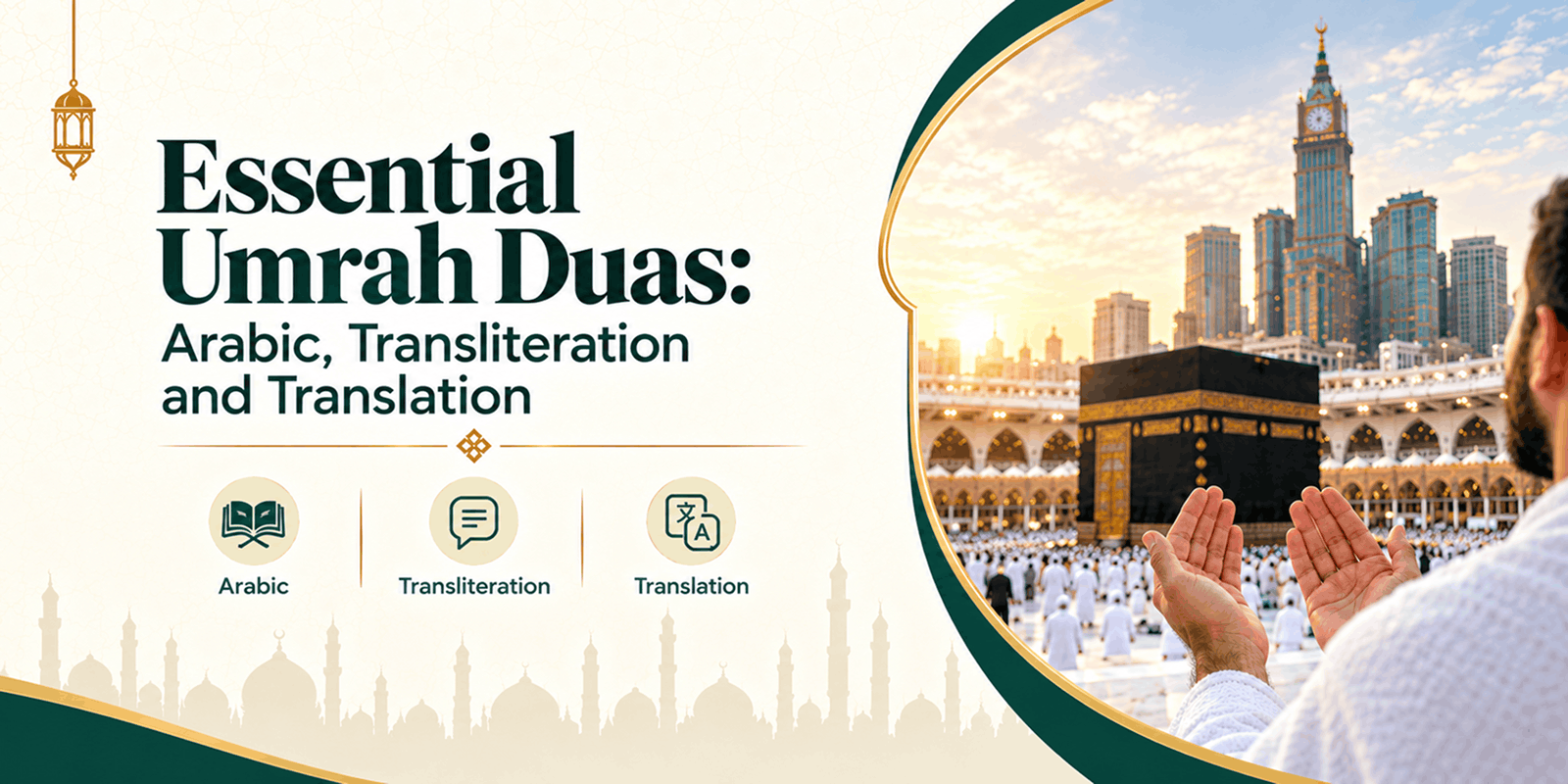
What should you say when you see the Kaaba? Which duas can you recite during Tawaf? And what can you ask Allah for as you walk between Safa and Marwa?
If these questions have crossed your mind while preparing for Umrah, you’re not alone. You may have personal duas you wish to make, but knowing the duas associated with each stage of the pilgrimage can also help you prepare before you leave home.
Al Hijaz Tours has put together this Umrah dua list, covering the stages before, during and after the pilgrimage. You’ll find Umrah duas in Arabic, with easy transliteration, English meanings and references to help you understand each dua.
We’ve also included an important reminder: you don’t need to memorise a different dua for every round of Tawaf to make your Umrah meaningful.
Ihram marks the beginning of your Umrah. At the Miqat, make your intention to perform Umrah and enter the state of Ihram.
You can say:
Arabic
لَبَّيْكَ اللَّهُمَّ عُمْرَةً
Transliteration: Labbayka Allahumma ‘Umrah.
Translation: “Here I am, O Allah, for Umrah.”
Reference: Reported in the context of the Prophet’s pilgrimage in Sahih Muslim, Book of Hajj.
The intention is in your heart. This wording expresses your intention to perform Umrah; do not worry about treating it as a compulsory formula that must be spoken in a particular way.
After entering Ihram, begin reciting the Talbiyah. It is a central supplication of pilgrimage and is repeated throughout the journey towards Makkah.
Arabic
لَبَّيْكَ اللَّهُمَّ لَبَّيْكَ، لَبَّيْكَ لَا شَرِيكَ لَكَ لَبَّيْكَ، إِنَّ الْحَمْدَ وَالنِّعْمَةَ لَكَ وَالْمُلْكَ، لَا شَرِيكَ لَكَ
Transliteration: Labbayka Allahumma labbayk, labbayka la sharika laka labbayk, innal-hamda wan-ni‘mata laka wal-mulk, la sharika lak.
Translation: “Here I am, O Allah, here I am. Here I am, You have no partner, here I am. Indeed, all praise, blessings and sovereignty belong to You. You have no partner.”
Reference: Sahih al-Bukhari 1549; Sahih Muslim 1184.
Men generally recite the Talbiyah aloud, while women recite it quietly. For Umrah, stop reciting it when you begin Tawaf.
When entering Masjid al-Haram, enter with your right foot first and recite the established supplication for entering a mosque.
Arabic
اللَّهُمَّ افْتَحْ لِي أَبْوَابَ رَحْمَتِكَ
Transliteration: Allahumma iftah li abwaba rahmatik.
Translation: “O Allah, open for me the doors of Your mercy.”
Reference: Sahih Muslim 713.
You may also say Bismillah and send blessings upon the Prophet ﷺ. The supplication asking Allah to open the doors of His mercy is the central wording reported for entering a mosque.
Seeing the Kaaba can be an emotional moment. You may have prayers for forgiveness, your family, guidance and the things you have hoped for over many years.
There is no single specific dua firmly established in authentic hadith that must be recited when seeing the Kaaba for the first time.
Instead, praise Allah, thank Him for bringing you to the Sacred House and make personal dua.
For example, you could say:
“O Allah, thank You for bringing me here. Forgive my sins, accept my Umrah, guide me towards what pleases You and bless my family.”
This is an example of personal dua, not a prescribed prophetic quotation. You can ask Allah for what matters to you in your own words.
Tawaf consists of seven circuits around the Kaaba, beginning and ending at the Black Stone (Hajar al-Aswad).
When you reach the Black Stone at the beginning of a circuit, say:
Arabic
اللَّهُ أَكْبَرُ
Transliteration: Allahu Akbar.
Translation: “Allah is the Greatest.”
Reference: Sahih al-Bukhari 1613.
If you can reach the Black Stone safely without pushing or harming anyone, you may touch or kiss it. If the crowd is dense, gesture towards it from a distance and continue walking. Do not push through other pilgrims.
Repeat the takbir when beginning each circuit.
During each circuit, when you reach the stretch between the Yemeni Corner and the Black Stone, recite this Quranic supplication.
Arabic
رَبَّنَا آتِنَا فِي الدُّنْيَا حَسَنَةً وَفِي الْآخِرَةِ حَسَنَةً وَقِنَا عَذَابَ النَّارِ
Transliteration: Rabbana atina fid-dunya hasanatan wa fil-akhirati hasanatan wa qina ‘adhaban-nar.
Translation: “Our Lord, grant us good in this world and good in the Hereafter, and protect us from the punishment of the Fire.”
Reference: Quran 2:201; Sunan Abi Dawud 1892.
This dua asks Allah for goodness in this life and the Hereafter. It is a useful supplication to learn before your journey.
No authenticated, fixed dua is prescribed for each of the seven circuits. You do not need to memorise seven different sets of supplications to complete Tawaf.
During the remaining parts of each circuit, you can:
You can repeat the same dua or make different supplications as they come to mind. Focus on your worship rather than worrying about completing a particular list for every circuit.
After completing seven circuits, pray two rak‘ahs and drink Zamzam water.
Praying two rak‘ahs
Pray two rak‘ahs after Tawaf, ideally near Maqam Ibrahim if space permits. If it is crowded, pray elsewhere in the mosque without obstructing other worshippers.
Making dua while drinking Zamzam
You can ask Allah for forgiveness, beneficial knowledge, good health, guidance and blessings for your family.
A supplication commonly associated with drinking Zamzam is:
Arabic
اللَّهُمَّ إِنِّي أَسْأَلُكَ عِلْمًا نَافِعًا، وَرِزْقًا وَاسِعًا، وَشِفَاءً مِنْ كُلِّ دَاءٍ
Transliteration: Allahumma inni as’aluka ‘ilman nafi‘an, wa rizqan wasi‘an, wa shifa’an min kulli da’.
Translation: “O Allah, I ask You for beneficial knowledge, abundant provision and healing from every illness.”
Reference note: This wording is commonly attributed to a supplication associated with Zamzam in Sunan Ibn Majah 3062. Its attribution has been graded weak by some scholars. It should not be presented as an unquestionably authentic prophetic dua specifically prescribed for drinking Zamzam. You can make any sincere personal supplication instead.
Sa’i involves seven lengths of walking between Safa and Marwa. It recalls Hajar’s search for water for her son, Isma‘il, and is an essential part of Umrah.
As you approach Safa to begin Sa’i, recite this verse from the Quran.
Arabic
إِنَّ الصَّفَا وَالْمَرْوَةَ مِنْ شَعَائِرِ اللَّهِ
Transliteration: Innas-Safa wal-Marwata min sha‘a’irillah.
Translation: “Indeed, Safa and Marwa are among the symbols of Allah.”
Reference: Quran 2:158.
Then say:
Transliteration: Abda’u bima bada’allahu bih.
Translation: “I begin with that with which Allah began.”
This follows the practice described in the hadith of Jabir regarding the Prophet’s pilgrimage.
When you reach Safa, face the direction of the Kaaba and recite the following remembrance. Repeat it when you reach Marwa.
Arabic
اللَّهُ أَكْبَرُ، اللَّهُ أَكْبَرُ، اللَّهُ أَكْبَرُ، لَا إِلَٰهَ إِلَّا اللَّهُ وَحْدَهُ لَا شَرِيكَ لَهُ، لَهُ الْمُلْكُ وَلَهُ الْحَمْدُ وَهُوَ عَلَىٰ كُلِّ شَيْءٍ قَدِيرٌ، لَا إِلَٰهَ إِلَّا اللَّهُ وَحْدَهُ، أَنْجَزَ وَعْدَهُ، وَنَصَرَ عَبْدَهُ، وَهَزَمَ الْأَحْزَابَ وَحْدَهُ
Transliteration
Allahu Akbar, Allahu Akbar, Allahu Akbar. La ilaha illallahu wahdahu la sharika lah, lahul-mulku wa lahul-hamd, wa huwa ‘ala kulli shay’in qadir. La ilaha illallahu wahdah, anjaza wa‘dah, wa nasara ‘abdah, wa hazamal-ahzaba wahdah.
Translation
“Allah is the Greatest. Allah is the Greatest. Allah is the Greatest. There is no god but Allah alone, with no partner. His is the dominion and His is the praise, and He has power over all things. There is no god but Allah alone. He fulfilled His promise, helped His servant and defeated the confederates alone.”
Reference: Sahih Muslim 1218, the long hadith of Jabir describing the Prophet’s pilgrimage.
The established practice is to recite this remembrance, make personal supplication, recite it again, make personal supplication, and repeat it a third time.
There is no compulsory dua for each round of Sa’i. While walking, you can remember Allah, recite Quran or make personal supplications.
You might ask Allah for forgiveness, good health, guidance, ease in your affairs and blessings for those you love.
Remember how the seven lengths are counted:
Men jog lightly between the designated green markers where possible; women walk at their normal pace. Follow the signs and local instructions, and avoid rushing in a way that risks injury.
Alongside the supplications associated with Ihram, Tawaf and Sa’i, you can make personal dua throughout your journey. These Quranic supplications are useful to learn and understand.
Arabic
رَبَّنَا ظَلَمْنَا أَنْفُسَنَا وَإِنْ لَمْ تَغْفِرْ لَنَا وَتَرْحَمْنَا لَنَكُونَنَّ مِنَ الْخَاسِرِينَ
Transliteration: Rabbana zalamna anfusana wa illam taghfir lana wa tarhamna lanakunanna minal-khasirin.
Translation: “Our Lord, we have wronged ourselves. If You do not forgive us and have mercy on us, we will surely be among the losers.”
Reference: Quran 7:23.
Use this dua to ask Allah for forgiveness and mercy, recognising your need for His guidance.
Arabic
رَبِّ ارْحَمْهُمَا كَمَا رَبَّيَانِي صَغِيرًا
Transliteration: Rabbir-hamhuma kama rabbayani saghira.
Translation: “My Lord, have mercy on them as they raised me when I was small.”
Reference: Quran 17:24.
This is a supplication for your parents. You can also make personal dua for your spouse, children, relatives, friends and the wider Muslim community.
Arabic
رَبَّنَا لَا تُزِغْ قُلُوبَنَا بَعْدَ إِذْ هَدَيْتَنَا وَهَبْ لَنَا مِنْ لَدُنْكَ رَحْمَةً إِنَّكَ أَنْتَ الْوَهَّابُ
Transliteration: Rabbana la tuzigh qulubana ba‘da idh hadaytana wa hab lana min ladunka rahmah, innaka antal-Wahhab.
Translation: “Our Lord, do not let our hearts deviate after You have guided us, and grant us mercy from Yourself. Truly, You are the Bestower.”
Reference: Quran 3:8.
Ask Allah to keep your heart firm upon faith and help you continue doing what pleases Him after returning home.
Arabic
رَبَّنَا تَقَبَّلْ مِنَّا إِنَّكَ أَنْتَ السَّمِيعُ الْعَلِيمُ
Transliteration: Rabbana taqabbal minna innaka Antas-Sami‘ul-‘Alim.
Translation: “Our Lord, accept this from us. Indeed, You are the All-Hearing, the All-Knowing.”
Reference: Quran 2:127.
Prophet Ibrahim and Prophet Isma‘il made this supplication while raising the foundations of the Kaaba. You can use it to ask Allah to accept your Umrah and other acts of worship.
After completing the seven lengths of Sa’i at Marwa, the final step is to shave or trim the hair to leave Ihram and complete Umrah.
There is no specific, authenticated dua that must be recited while shaving or trimming the hair.
Once you have completed the required rites, you can ask Allah to accept your pilgrimage. You may recite the Quranic dua for acceptance above or make personal supplication.
Yes, if you have not memorised all the supplications, reading them from your phone or a booklet can help you follow the guide and understand what you are reciting.
A few simple steps can help:
Preparing for Umrah is about more than the journey itself. At AlHijazTours, we offer ATOL-protected Umrah packages with flights, accommodation and transport to help you plan your trip. Explore our available Umrah packages from across the UK and find an option that suits your travel needs.
Forgetting an optional dua does not invalidate your Tawaf or Sa’i. There is no fixed wording for every circuit, and you can pray in your own words. If you think you have missed or incorrectly performed an essential part of a ritual, ask a qualified scholar for advice about your circumstances.
There is no single specific dua firmly established in authentic hadith for this moment. Praise Allah, thank Him for bringing you to the Sacred House and ask for forgiveness, guidance and acceptance of your Umrah.
The Talbiyah is a central part of Ihram. During Tawaf, the verse from Quran 2:201 is established between the Yemeni Corner and the Black Stone. At Safa and Marwa, there is also an established remembrance. You can make personal dua throughout your pilgrimage as well.
Yes. You can make personal dua in your own language. For prescribed Arabic wording and Quranic verses, learn the original as best you can. If you have questions about what may be said during formal salah, seek guidance from a qualified scholar.
No authenticated, fixed dua is assigned to each round. You may recite Quran, remember Allah and ask for what you need throughout Tawaf. You do not have to memorise seven separate lists.
No. Learning the main duas beforehand can help, but you do not need to memorise a long list. Use a reliable guide, learn the meanings and make personal dua in your own words.
Talk to our travel specialists and get the best available options tailored for you.
Get Started